










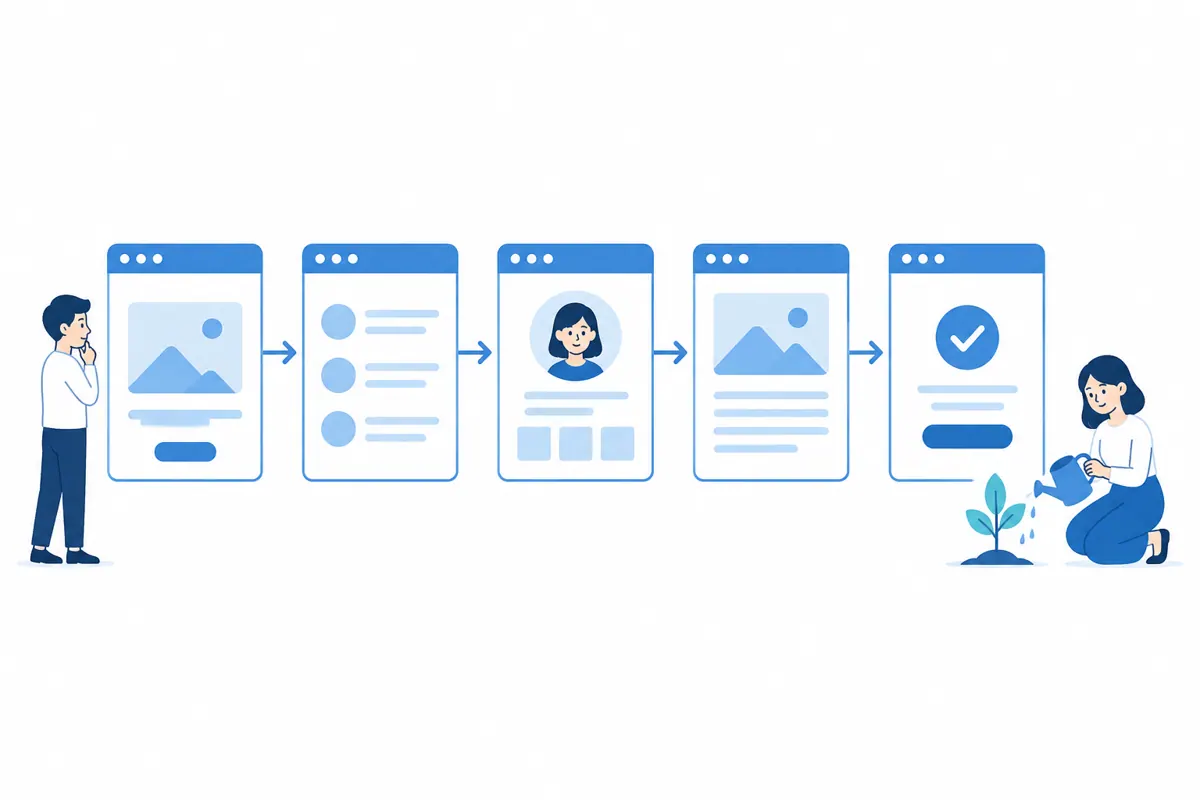
For a small or medium-sized business, a website can start with around five pages: a company overview, services, a price guide, case studies, and a contact page. Rather than aiming for the finished article from day one, it costs less money and less effort to publish, watch how many inquiries come in and how people find you in search, and then add the missing pages one at a time.
Launch with about five pages first, then grow from there
For a small or medium-sized business, the realistic approach is to publish with the minimum set of pages that leads to inquiries, then add more once you can see the numbers. Building 20 or 30 pages from the outset takes a long time to launch, and the work often moves ahead before the content itself is settled.
There are three advantages to starting small.
- You launch sooner, so you also start appearing in search results sooner
- Initial costs are low, so the damage is limited if things don't work out
- You can decide which pages to add after seeing how real visitors behave
Instead of building something large and finishing it in one go, publish something small and grow it. This is the natural approach once you see your website not as a brochure you finish and forget, but as a sales channel for your company.
The first five pages and the role of each one
Even with only about five pages at the start, the site will work as a sales channel as long as each page has a clear role.
- Home page. The first screen tells visitors what kind of company you are and whose problems you solve
- Services page. Pick the one service you most want to sell, and describe what it involves and how it works
- Price guide page. Simply showing “prices start from” lowers the barrier to getting in touch
- Case studies and customer testimonials page. Include the words of people who actually used your service, along with what the work involved
- Company overview and contact page. Bring your address, phone number and inquiry form together in one place
Even if your company has several services to sell, start by narrowing down to the one you most want inquiries about. If you list everything, visitors will leave without ever working out what kind of company you are.
Step-by-step process for starting small
- Decide who you want to sell to and which single service you want to sell. If the owner and the sales team disagree, settle it internally first
- Write down three to five words those people are likely to use when searching. Choose the wording customers actually say out loud, not industry jargon
- Decide the structure of the five pages, and put the conclusion in two or three lines at the top of each page
- Prepare the text and photos. Photos taken on a smartphone of your own site or staff are perfectly useful as long as they are real
- Publish. Don't wait for perfection; go live once the structure is in place
- For the first month after launch, watch the number of inquiries, which pages are being viewed, and the words used in search
- Using what you see as a guide, add one page covering the information that's missing. Review the numbers again the following month
Many companies skip steps 2 and 6, and the ones that skip them are the ones most likely to feel that “we built a site but no inquiries come in.”
Which pages to add first
Decide which pages to add after launch based on whether they are read before people get in touch. A rough order is as follows.
| Page to add | Why add it | Rough timing |
|---|---|---|
| FAQ | If the same question keeps coming in by phone or email, you can answer it up front | One month after launch |
| Individual pages for each service | When you find that people are searching for specific service names | Two to three months after launch |
| Detailed case study pages | When the case studies page is being read and people want to know more | Around three months after launch |
| Column and news posts | When you want to widen your entry points from search. Decide on a frequency you can keep up before you start | Three months after launch or later |
| Recruitment page | When hiring is also a challenge. Build it separately from your sales pages | When the need arises |
Base the order on numbers, not on hunches. Look at what is being read and where people drop off, then choose your next page.
Three typical ways starting small goes wrong
Nobody looks at the numbers after launch
If you treat launch day as the finish line, improvement never begins. Block out time in your calendar in advance, once a month, to review inquiry numbers and the pages people viewed.
The five pages are nothing more than a company self-introduction
A site that devotes a lot of space to company history and a message from the president, while saying little about customers' problems and how you solve them, won't work while it stays small. Write those first five pages in the order of what customers want to know.
No one has been chosen to handle updates
After launch, when you want to fix some wording or swap out a photo, updates grind to a halt if you don't know who to ask or what it costs. Deciding before launch who makes changes and how much they cost is the foundation for growing the site.
How to think about the cost
The cost of building a website varies greatly depending on who you hire and what is involved. According to research by Web Kanji, when a small or medium-sized business commissions a website, the average cost is 1,044,000 yen and the median is 573,000 yen.
If you start small, the idea is to launch for less than the median of that range and spend the rest during the growth stage. Initial cost isn't the only thing to look at. Compare these three together.
- Initial cost. This depends on the number of pages and how much of the design and copywriting you outsource
- Monthly cost. Check whether the server, maintenance and update requests are included
- The cost of additions after launch. Ask up front how much adding one page costs
At Merci Ltd., for example, the AI-led site-factory starts from 30,000 yen initially and 7,000 yen per month (excluding tax), while made-to-order production led by our creators starts from 250,000 yen initially (around five pages) and 3,000 yen per month. You can choose based on your goal: the former if you want to start small, the latter if you want to work through your strengths and build a custom design.
When starting small is not the right fit
For companies like the following, it may be better to build at a larger scale from the start.
- Companies with multiple divisions or locations, where the types of visitors are clearly different
- Companies that need functionality such as bookings or online sales in place at launch
- Companies whose top priority is hiring and who want job listings to appear in search
Even in these cases, rather than building everything at once, plan by separating what's needed at launch from what can be added later.

An example of how the first three months go
Here is an illustrative example of how a company that starts small might proceed over three months, assuming one service and five pages.
- Month 1. Right after launch, look at which pages are read before an inquiry rather than at traffic. If the pricing page is widely read, the way you present prices is part of how people decide to contact you
- Month 2. Count whether the same question has come in three or more times by phone or email. If it has, put that question and its answer on your FAQ page
- Month 3. Look at the words used in search, and if people are arriving via words you didn't expect, add an individual service page with those words in the headings
In this way, decide which pages to add based on what has actually happened. Pages added on the basis of internal guesswork tend to sit there unread.
Deciding not to add is important too
There's no need to keep adding pages that no one reads. If a page still isn't being read after three months, rewrite its title and the first two or three lines in the words people actually search with. If it's still not read, merging or deleting it are options too. A large number of pages is no measure of results.
What to agree on internally
Decide these three things internally before launch and you won't get stuck during the growth stage.
- Who handles incoming inquiries, and the target number of days for a reply
- Who reviews the numbers once a month, and when
- Who collects photos and case studies
How to decide when opinions differ internally
When opinions split into “we want to include this too, and that as well,” settle on a single criterion for what goes on the site. That criterion is: “Is this something the customers we want inquiries from need to know while they are making up their minds?” Keep company history and boasts about your equipment in one place on the company overview page, and put only the information customers need to make a decision on your service pages.
FAQ
About five pages is a good guide: company overview, services, price guide, case studies and contact. If you narrow down to one service you want to sell, even five pages can be structured to generate inquiries.
The cost of adding pages varies by provider. Before commissioning the work, check the cost of adding a page and the scope of updates included in the monthly fee, and you'll have a clear view of your budget.
Rankings aren't determined by page count alone. It is more effective to publish pages that answer what searchers want to know and then develop the content.
If you can take the time to think through the copy and structure, building it in-house is one option. If sales and on-site work leave you with no spare capacity, hiring a production company that can handle the structure and copy as well will get you to launch faster.
It depends on the provider. Whether you can request text and photo updates by chat or LINE has a direct bearing on how easy it is to keep going after launch, so ask before you sign a contract.
Let's build your start-small plan together
Once you've decided on the first five pages and the order in which to add more, your website project is already half done. At Merci Ltd., we plan it with you, from identifying your strengths to narrowing down the first pages to build and growing the site after launch.