


If you use a computer for work every day, you're surely running internet searches several times a day.
By the way, did you know that search engines these days read users' intent from their search phrases and reflect it in the search results?
What does that mean?
Before we explain, let's take a look at some screenshots of search results.
(It's much quicker that way.)
When searching for [Italian Hamamatsu]

Results when searching for [pasta recipe]

Results when searching for [pasta mail order]

Did you spot the differences? Of course you did!
Depending on the intent of the search, the order of the search categories—"All, Maps, Shopping, News, Images"—changes.
When you search with a "business name + area name" like [Italian Hamamatsu], Google judges that the map showing locations has the highest priority = the greatest user need.
For [pasta recipe], it judges that images showing how to make pasta are exactly the information the user is looking for.
For [pasta mail order], just as the words say, it judges that information about products available by mail order—i.e. online purchase—takes top priority.
As you can see, the information users are looking for differs completely depending on the search phrase, and Google provides finely tuned information that reflects those intentions.
Incidentally, when we search the same phrases on Yahoo!, the results look like this:
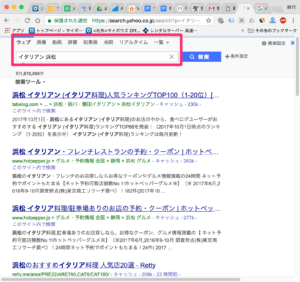
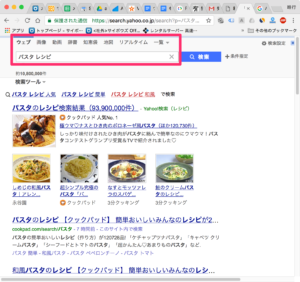

All in the same order... It seems the search display isn't as finely tuned as Google's.
What can we notice from how Google displays search results?
What can we learn from these facts?
Google has evidently decided that "the more interest users have in a type of information, the more placing it on the left side of the menu improves usability."
Otherwise, there would be no need to go to the trouble of changing the order.
This should serve as a useful reference when we create websites.
Today, websites designed for PC users line up menu buttons known as "global navigation" horizontally.
When arranging these buttons, wouldn't placing the pages users are most likely to be interested in on the left side make them more likely to be clicked?


