


This happened the other day while I was talking with a certain company president.
He asked me, "Google search rankings are basically in order of popularity, right?"
He wasn't someone with much interest in the web, websites, or online marketing and all that, so
I cheerfully answered, "Yep, pretty much! You can think of it that way and you'll be fine!!"
If you have some interest in search ranking optimization, you probably know that Google is said to determine search rankings based on a great many indicators.
That said, the idea that "search ranking = popularity ranking" is said to be carrying more and more weight lately.
So today I tested that point using a free tool.
What were the results? …Please read on to find out!
We tried using metrics from free competitor research tools
First of all, what exactly does "popularity ranking" mean? For this article, we decided to define "popular = lots of traffic."
Now, to check the exact traffic of your own site you would use Google Analytics, but of course you can't use that on external sites.
So this time we decided to look into it using "competitor research tools," which let you check traffic conditions for sites other than your own.
The tools we actually used were "Similar Web" and "Alexa."
"Similar Web" was launched by Israeli entrepreneur Or Offer as SimilarWeb Ltd. (the company is now headquartered in London). "Alexa" is a service provided by none other than Amazon.


Both are easy to use. Just enter the URL of the site you want to research into the search box on the Similar Web or Alexa site and run it.
Incidentally, from Similar Web we took the monthly number of visits, and from Alexa we took the traffic rank figure (it may be easier to think of it as an access ranking). In other words, the higher the Similar Web figure and the lower the Alexa figure, the better the score.
So which sites did we research? This time we used search phrases likely to be local business searches:
"Hamamatsu-shi sekkotsuin (osteopathic clinic)," "Shizuoka-shi gaiheki reform (exterior wall renovation)," "Shizuoka-shi homepage production company"
and researched the top 20 results displayed for each.
Here are the results
Please note that we have hidden the individual company names that appeared in the search results here.
There is a view that search results fall under a company's privacy, and publishing them without permission may go against that.
*Items shown in gray are portal sites or nationwide-level services. These are listed as they are.
[List of search results for "Hamamatsu osteopathic clinic" and competitor research results]

[List of search results for "Hamamatsu osteopathic clinic" and competitor research results]


[List of search results for "Hamamatsu osteopathic clinic" and competitor research results]

The overall trend is that the more traffic a site has, the higher it ranks in search
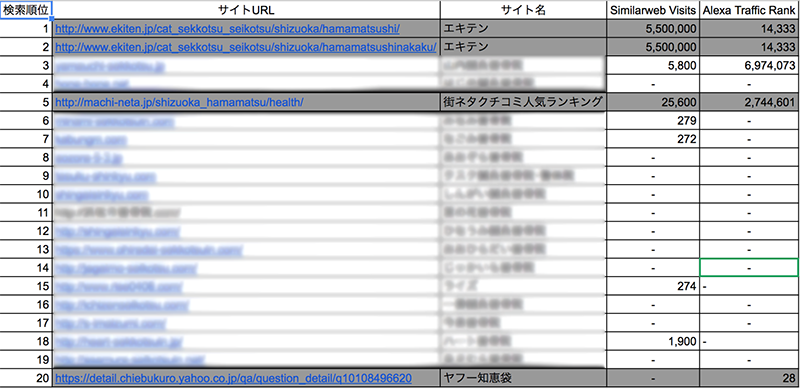
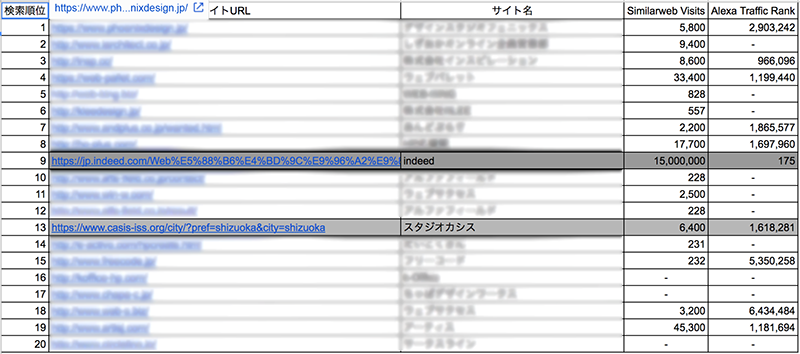
It's a little hard to see, but if you look at the table, you can observe an overall trend where sites with more traffic (that is, more popular ones) have an advantage in search rankings.
For "Hamamatsu-shi osteopathic clinic," the first and second spots are taken by Ekiten, in other words an industry-specific portal site. The same tendency tends to appear for salons and restaurants as well, where sites like Hot Pepper and Tabelog tend to come out on top. You can see that major portal sites that attract customers on a nationwide scale have traffic on a completely different order of magnitude.
From the 8th position onward, most entries show " – " — that is, blanks — for both Similar Web and Alexa.
One reason for the blanks is low traffic. Blanks can occur even with high traffic, but as you can see from the other search phrases as well, the lower the ranking, the more blanks there are.
If you want to raise your search ranking, raise the traffic to your site... it's a bit of a chicken-and-egg situation.
Even so, these two go hand in hand in online customer acquisition, so let's keep both in mind.


