


Hello. This is Ochiai.
In this blog post, I'd like to talk about drones for personal use.
Drones are now used in many industries, and their evolution and spread show no signs of slowing down.
Recently, not only companies but a great many individuals own drones as well, and since they are sold on shopping sites such as Amazon and Rakuten, you can buy one just like any home appliance.
The major drone development companies are France's Parrot, America's 3D Robotics, and China's DJI.
This time, I'd like to introduce the safety features of the "Phantom 4," a drone made by DJI of China, one of those major manufacturers.
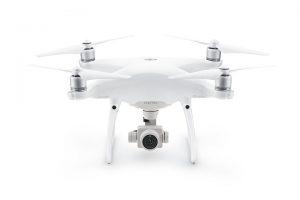
Features of the Phantom 4
The Phantom 4 is equipped with an obstacle detection function that automatically avoids obstacles, as well as a function that automatically returns the aircraft to its takeoff point when there is a risk of it falling during flight, such as an aircraft error, low battery, or loss of communication with the controller. This is the Return to Home function, which works not only in emergencies but also at the push of a button, automatically returning the drone to the takeoff point or a registered point. (Since this function uses GPS signals, a stable GPS signal is required.)
In addition, it has a function that lets it fly automatically in a given direction simply by tapping the smartphone screen, and a function that automatically tracks a target while avoiding obstacles, making it a very reassuring aircraft even for beginners who are not used to piloting. (That said, you never know what might happen, so avoid reckless flying until you can pilot it properly!)
It is an excellent machine, but that assumes the settings and condition are properly managed. Also, GPS is essential for the Phantom 4 to fly automatically. In places where the GPS signal is unstable, you have to operate it manually, which naturally means hovering manually too, so there is a risk of being carried off by the wind.
Currently, in no-fly zones or near airports, the Phantom 4's motors will not even start, so it cannot fly.

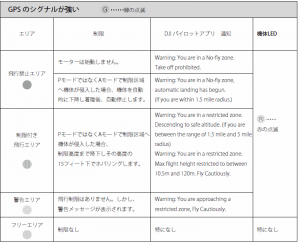
As shown in this table, restrictions using GPS are in place. These restrictions apply to all DJI products.
If you switch to a mode that flies without using GPS signals, these restrictions don't apply, but as I wrote above, that is very dangerous. Also, when asked what happens if you try to enter a no-fly zone with the motors running or while in flight, I looked into it and found that it's as if an invisible wall appears and you simply cannot go any further.
Laws concerning drones have been established, and automatic flight regulations for drones are planned for 2018. Under these, aircraft without permission will be restricted in flight and altitude in no-fly zones and restricted areas, and only authorized aircraft will be able to fly.
Many people who currently own drones probably wonder, "So where can I actually fly my drone?" But if drones simply can't fly in prohibited areas, that makes things very easy to understand. (As for DJI products, restrictions already exist, as shown in the table above. You can check no-fly zones via the No-Fly Zone section of the app.)
You may remember the incident where a drone crashed at the White House. That was actually a DJI product as well, the "Phantom 2."
Some may think, "Crashing? Drones are dangerous!" but in that incident, the pilot was apparently drunk (*_*;
There have been other issues as well, such as a drone falling at the Prime Minister's Office, but thanks to DJI's response, takeoff and flight within one kilometer of the Imperial Palace and the Prime Minister's Office are now impossible.
As you can see, DJI responds to such matters right away.
Not just for the aircraft's performance but also for the developer's swift safety measures, I personally recommend the Phantom.
(Newly added no-fly zones are updated along with app updates. To enjoy safe flights, be sure to keep both the app and the aircraft properly updated.)
The Phantom connects to a smartphone or tablet, which you use as a monitor. Settings are also configured within the smartphone or tablet app, and updates to the aircraft and controller are performed when connected to a smartphone or tablet. I had been using an iPhone as my monitor, but when I changed models, I got greedy and switched to an iPhone Plus with its bigger screen! (lol)
I'd like to try shooting with a large screen like an iPad, but personally I felt that a regular iPhone is plenty.
This time I talked about safety, and next time I'd like to talk about the Phantom 4's camera!


