



Hello. This is Ochiai, the designer.
When you post photos on your blog or social media, are you aware of the risk that those photos might be used somewhere without your knowledge?
Content theft within digital media is something we hear about often these days.
We hear all sorts of stories—blogs copied wholesale, or photos of food, scenery, and even family and children posted on Facebook and other social media turning up on the accounts of complete strangers.
There have even been cases where someone's artwork was turned into a smartphone case and sold without them knowing.
That's why you need to protect not only photos used by your company but also your personal photos from theft yourself.
The measure used for this is the watermark.
Put simply, it means clearly putting your name on your photos and works.
Adding a watermark should go a long way toward preventing unauthorized reproduction and use.
In this blog, I'll cover the topic over two posts, explaining how to do it on a PC and how to do it on a smartphone.
Add a watermark to your photos with your smartphone
Let's start with how to do it on a smartphone.
If you don't have a computer, you'll be using an app to add watermarks to your photos.
With a computer you can embed copyright information into the photo's data, but on a smartphone you add a visible signature within the image itself.
Since the image may end up being cropped, placing the mark where it can't be cut off should help deter unauthorized reposting even more.
There are various methods, but this time we'll use a free app called "snapseed", which is available for both iPhone and Android.

This app is photo editing and shooting software, not an app dedicated to watermarks. However, it's very easy and intuitive to use and excellent for photo editing as well, so there's nothing to lose by installing it.
When you first launch it, you'll see a screen like this.

Tap "Open" in the upper left to select an image.
If you choose "Open from device," you can select and edit a photo you've already taken.
Tap "Camera" to launch the camera and shoot in RAW.
This time we'll use a photo taken in advance with a smartphone.

This one was shot with a smartphone at Kyotokuike Park in Kakegawa City.
There's text in the lower right of this photo. That's the watermark.
Now let's go through how to add a watermark, step by step.
Adding it as text
When you open an image, a pen-like icon appears in the lower right; tap it to enter the editing screen.

You'll then see a screen for selecting editing options, so tap "Text."

Next, as shown on the screen, double-tap the text to enter your wording.

Since this is a watermark, enter your company name, logo, account name, copyright holder name, or your own signature. This time we'll enter text rather than a logo.
By selecting the word "line" at the bottom of the screen, you can change the font and style. Slide to the right to see plenty of variations and pick the one you like.
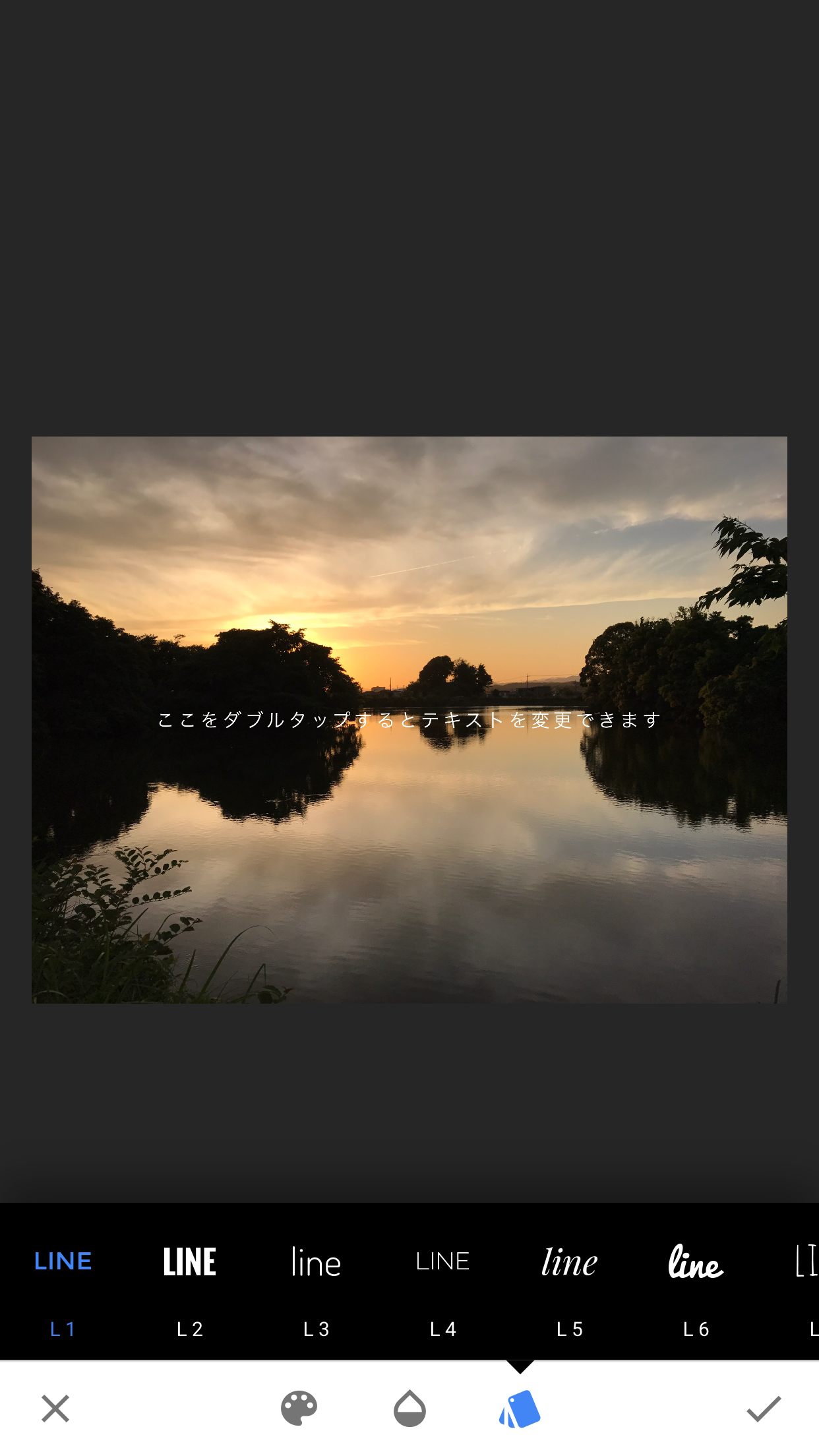
Next, select the droplet-shaped icon in the white area at the very bottom of the screen to change the opacity. This makes the photo underneath show through.
Just like moving the text with one finger and pinching to zoom with two, you can also adjust the size of the text.

Once you've set the size, position and opacity as you like, you're done. Tap the check mark in the lower right of the screen to complete the work.
Tap "Save" at the top of the screen to save the edited image to your device.
There are lots of color variations and you can even invert the colors, so you can create images like this one too.


Adding a logo to a photo
Next, if you'd like to add a logo rather than text using your smartphone, please refer to the following.

Now let's add a logo as shown in the image.
First, save the logo you want to use to your smartphone.
This process is divided into two steps.
1. Making the logo background transparent
Even if you send transparent-background data from a computer to your smartphone, on many devices the background doesn't stay properly transparent.
So first we'll use an app to make the background transparent.
This time we'll use a free app called "Haikei Touka" (Background Eraser), which is available for both iPhone and Android.

Once you open the app, choose "Open from album" and select your logo.
If you're in the situation of "it should be transparent data, but when I saved it on my phone there's a white background," the app automatically displays it with the background removed, so you can simply save it as is.
For images that weren't transparent to begin with, such as phone snapshots, you'll need to tap the areas you want to erase several times, so use transparent PNG data whenever possible.
Once the background is transparent, tap Export at the top of the screen to save it to your device.
2. Adding the logo
Next, let's add the logo created in step 1.
From here we'll use an app called "LINE Camera," which is available for both iPhone and Android.

Launch LINE Camera and select the photo you want to add the logo to from "Album." Next, tap Edit in the lower right and select the heart icon at the bottom.

You'll see a scissors icon, so tap it.

Select "+" and choose the transparent-background logo you just created.
After that, tap the arrow at the lower right of the box around the logo to adjust its size, and use the sun-like icon at the lower left to adjust opacity, hue, saturation and brightness.
And that's it.
Once you've created a transparent-background logo, you can reuse the same one from then on, so from the second time you can add the logo using only LINE Camera.
That's how to add a watermark on a smartphone.
These days, many people shoot and edit on their smartphone and post directly without using a computer.
But photos posted online can be saved by anyone, so there's no telling how they might be used.
So please try using watermarks as a measure against unauthorized use.
Next time we'll explain how to add watermarks using a computer.


