



Hello, this is Ochiai, the designer.
In this blog post, I'll introduce how to add watermarks on a computer, using both paid and free software.
A watermark is like a signature written into an image or video, displaying information such as an account name, company name, logo, or copyright details within the image.
This helps deter unauthorized use and reproduction.
So what exactly counts as unauthorized use or reproduction?
For example, say you upload a photo, an illustration, or some other work of your own to social media or a blog.
A third party then downloads it on their smartphone or computer and posts it on social media or a blog, or prints and distributes it — in other words, uses it a second time without your permission.
We all know that using someone else's belongings without permission is wrong — it's obvious if you think of physical possessions — yet online this happens on a daily basis.
It's not unusual for your own work to be uploaded as someone else's, or for photos of you or your family to be used by complete strangers.
To prevent this, it's very important to indicate that the work is yours.
① Use Lightroom (paid)
This software is a photo editing tool and is a little different from paint-type software like Photoshop, but when it comes to bringing out the very best in an existing image, it's an excellent program in terms of both efficiency and usability. If you already use Lightroom but don't normally use watermarks, definitely give the method below a try.
Now let's add a watermark using Lightroom.
Launch the software and select the photo you want to edit.

This may be confusing for first-time users, but to edit photos in Lightroom you first need to import a folder using the "+" next to "Folders."
A list of the photos in that folder will then appear at the bottom of the screen, and you can select a photo from there.
The photos in the selected folder are immediately ready to edit, so once you've imported the folder there's no need to "open" anything. Lightroom edits while keeping the original photo data intact, so the photo isn't changed at all unless you export it. That means that after editing, you need to export the photo in the format you require. You can add a watermark during this final export step.
Once you click "Export," scroll down the screen, check the "Watermarking" box, and select "Edit Watermarks…"

A box like the one in the image will appear, and here you type in the text you want to use as your watermark.

From this screen you can also edit the text size, position, opacity, and more.
If you want to insert a logo, choose your logo under "Image Options."

When you're finished editing, click "Done" and then "Export" — and you're done.
Since you can add a watermark as part of your image editing workflow, this is a very welcome feature for anyone who uses this software regularly.
② Use Photoshop (paid)
This software is a paint-type tool, so you can create watermarks exactly as you like.
Whether with the text tool or by hand using a pen tablet, you can freely edit the color, shape, opacity, and even texture. Of course, you can also import and add a logo.
For Photoshop, however, I'd like to introduce a slightly different approach.
Did you know you can install plugins in Photoshop?
Plugins are programs used to add features to Photoshop.
There are free plugins too — from the Photoshop screen, open "Help" in the menu and choose "Browse Plug-ins and Extensions" to add all sorts of functionality.
Among them is a plugin called Digimarc. It lets you embed invisible copyright information into your media, and the embedded copyright data isn't lost even if the image is cropped, copied, or converted to a different file format.

The plugin itself is free, but to use Digimarc's technology you must register on their site and purchase a license. Licenses are annual and come with a limit on the number of images.
Once you've installed the plugin, registered a Digimarc account, and purchased a license, you can use it from the Filter menu within Photoshop.
Lightroom and Photoshop are themselves paid software, and while those who own them can add watermarks as part of their editing, adding a Digimarc license fee on top may be a bit much financially for an individual.
So let me introduce a free online watermarking tool.
③ Add watermarks online (free)
There are all kinds of tools out there, but I'd like to introduce a site called WATERMARK.

It's easy to use. Once you access the site, click "Get Started."

Choose where to load your images from and import them.
When the imported photo appears on the site, hover your cursor over the image.
The word "Edit" will appear — click it.
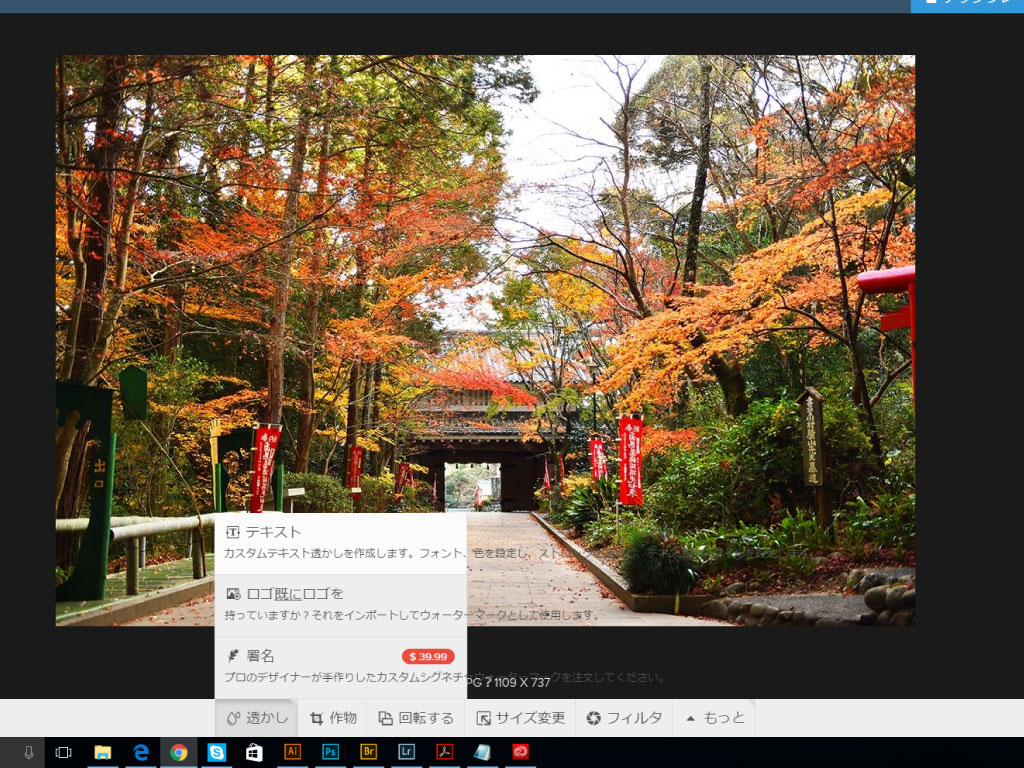
Once you're in the editing screen, select "Watermark" at the bottom of the screen, where you can choose whether to enter text or insert a logo.

You can change not only the opacity but also the color, and you can even tile the logo across the image.
When you're done, click Finish at the bottom right of the screen. Press Download to save it to your computer, and you're finished.
This is very easy to understand and anyone with an internet connection can use it, so I highly recommend it.
That said, this isn't a digital watermark — it simply writes text onto the photo — so there's a risk of secondary use if the image is cropped. For that reason, I recommend placing it where it's hard to crop out.
That covers the three methods here, and in my previous blog post I also introduced how to do it on a smartphone.
I draw illustrations myself, and I fairly often come across people posting others' artwork on social media claiming it as their own, or using it without permission as an icon or an image on their own website. Illustrators suffer all sorts of harm as well, such as finding their illustrations turned into products without their knowledge.
There have even been cases where family photos someone posted were used in scams.
This happened overseas, but there was also a case where someone posted a photo of another person's child claiming it was their own, causing quite a stir.
In a world where you never know how the photos you post might be used, find the method that works best for you and give watermarks a try.


