










A personal gym website brings in trial bookings when it is built so that readers can picture themselves training there. Five things are essential: who the gym is for, what happens in a single session, the prices, how the trial works, and how easy it is to book. Before you worry about appearances, answer these five in order, starting on the first page.
Websites that bring in trial bookings answer three questions on the first screen
The first screen needs to show three things: who the gym is for, what kind of change the visitor can aim for, and how to book a trial. People who open your website decide within seconds whether the place is relevant to them. Before you go into detail about the trainer's background or the gym's philosophy, these three questions must already be answered.
People looking for a personal gym carry a predictable set of worries. Will I be able to keep it up? Will they push me into a hard sell? How much will it actually cost in the end? Will I be comfortable being seen exercising in front of others? The job of your website is to clear away these worries one by one, before the visitor books a trial.
The seven items to include, and the order to place them in
Arrange the following seven items from the top down. The order follows the order in which readers want to know things.
- Who the gym is for. Be specific about goals. Narrow it down to two or three types of people you want to attract — those who want to slim down, improve their posture, are nervous because they haven't exercised in a long time, or are rebuilding their body after childbirth. If you say the gym is for everyone, it resonates with no one
- How training here will change them. Rather than numbers on the scale, describe the changes they will feel in daily life, such as stairs becoming easier or clothes becoming easier to choose
- What a session looks like. Lay out everything from arrival and changing to the consultation, the training and the finish, along with rough timings
- The trainer's face and words. Include a photo and a description of the kinds of clients they have worked with. In this industry the person is the deciding factor, so never leave this out
- Pricing. Put the price per number of sessions, whether there is a joining fee, payment methods and the cancellation rules into a single table
- What the trial includes. State the duration, what to bring, the price, the flow on the day, and that it is fine to stop after the trial
- Location and opening hours. Directions from the nearest station, whether there is parking, opening hours, and whether there are changing rooms and showers
Arranged in this order, readers' worries fall away one by one as they move down the page, and they arrive at the trial booking at the end. Place the trial booking button on the first screen and at every break between the seven items. Never build on the assumption that people will read all the way to the bottom.
Don't hide your prices — show them in a table
A personal gym website that doesn't show prices loses visitors before they ever get in touch. Personal training is a big purchase, and without figures visitors can't even compare you with anyone else.
The trick is not to show the amount on its own, but to list what is included with it.
| Item to include | What to write | What happens if you leave it out |
|---|---|---|
| Price per number of sessions | The monthly cost for a given number of sessions per month | You never make the shortlist |
| Joining fee | Whether there is one, and how much | Visitors suspect extra charges after signing up |
| Nutrition guidance | Whether it is included or costs extra | Mismatched expectations cause disputes after joining |
| Payment methods | Cash, card, instalments | People stall at the final step of signing up |
| Cancellation rules | By when and how they can cancel | They leave still worried about whether they can keep it up |
If you are hesitant to publish exact figures, start with a price range and explain that the formal quote is given at the trial. Showing nothing at all is the worst option.
The less effort a trial booking takes, the more you get
Keep your trial booking form to the bare minimum. Three required fields are enough: name, contact details, and preferred date and time. Goals and exercise history can be covered in the consultation on the day of the trial. The more fields there are, the more people give up partway through.
Offer several ways to book. The three basics are a form, the phone and LINE. LINE is a channel people use every day, so it makes asking questions easy. It also works as a place to send “things I'd like to ask before the trial.” If you use a booking service, link your website buttons straight to that screen.
The screen shown after a booking is completed matters too. Stating what contact to expect next and what to bring on the day reduces last-minute cancellations.
There are rules for showing photos and results
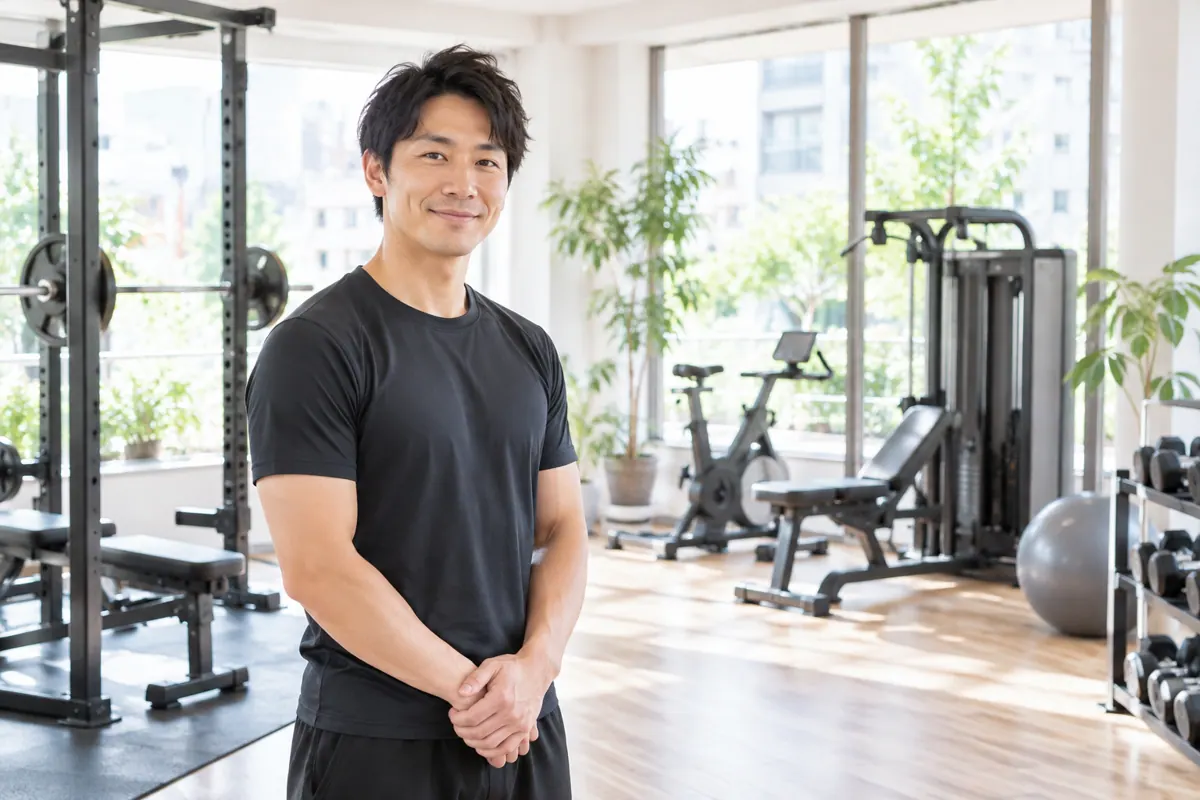
Gather four kinds of photos: the trainer's face, the gym as a whole, the equipment, and training in progress. The atmosphere of a gym cannot be conveyed in words. Photos of the changing room and the entrance make a first visit feel less daunting.
Before-and-after photos need care. When you publish them, include the time period, the number of sessions attended and conditions such as diet, and avoid wording that implies everyone will get the same result. The Consumer Affairs Agency treats representations that make results look significantly better than reality as misleading representations under the Act against Unjustifiable Premiums and Misleading Representations. Absolutes such as “guaranteed weight loss” or “anyone can” not only damage trust, they may also breach the law.
When you publish customer testimonials, get the person's permission and use their actual words as given. Never post invented testimonials.

Common mistakes on personal gym websites
No defined audience, so the copy is aimed at everyone
If you open with a line like “Toward your ideal body” that could apply to anyone, readers won't feel you are talking to them. Decide who you want to attract and write in that person's words.
Relying on a booking service page alone
Booking services are convenient, but they can't fully convey your gym's philosophy or the trainer's personality. Use the booking service as an entry point for sign-ups, and use your own website to explain why people should choose you.
Hard to read on a smartphone
Most people looking for a trial search on a smartphone. If tables run off the side, buttons are small, or text is too thin, visitors close the page before booking. Before you go live, tap through the whole site from start to finish on your own phone.
Not appearing in map searches
Many people search from a map with queries like “personal gym near me,” so registering and maintaining a Google Business Profile is every bit as important as your website. Make sure the business name, address, phone number and opening hours match your website word for word.
What to check when hiring a web design company
When commissioning a personal gym website, check these four points at the quotation stage.
- Whether the design of the trial booking button and form is included. Some quotes cover visual design only
- Whether you can request text and photo updates at any time after launch. Price tables and campaigns change frequently
- Whether checking how the site looks on smartphones is part of the process
- How far they will support search and map search visibility
We offer two options: AI-led site-factory (from 30,000 yen setup and from 7,000 yen per month, excluding tax) and creator-led bespoke production (from 250,000 yen setup and from 3,000 yen per month). Which suits you depends on whether you want to launch quickly and cheaply, or build carefully starting from identifying your gym's strengths.
A three-step process for rewriting the copy on your first screen
Rewriting the copy on your first screen in the following three steps makes a difference in a short time.
- Read your current first screen as if you were someone who might come in for a trial. Check whether there is even one line that makes you think, “That's me”
- Narrow your target down to a single type of person and turn the worry they would actually voice into your headline. For example, “It's been a long time since I exercised, and walking into a gym makes me nervous”
- Directly below the headline, place the trial booking button alongside the trial price. When people click with the price in view, fewer of them back out afterwards
Decide in advance what happens after a booking comes in
The communication between a trial booking and the day itself is also part of what your website achieves. Decide these four things in advance.
- How quickly you reply to a booking. Same day is a good benchmark
- What to include in the reply: confirmation of the date and time, what to bring, whether a change of clothes is needed, and directions to the gym
- A reminder sent the day before. Sending it via LINE cuts down on no-shows
- A thank-you message after the trial, plus membership information. This gives people who couldn't decide on the spot something to think over
Once you have templates for these messages, your follow-up stays consistent even as bookings increase. Treat efforts to increase bookings through your website as a set with your reply process.
FAQ
Check whether your first screen shows who the gym is for and includes a trial booking button. Next, publish your prices in a table. It is not unusual for these two changes alone to shift the number of enquiries.
More people leave when prices are unclear and they can't check. If you also list what is included, how people feel about the amount changes.
A one-trainer gym needs one all the more. In an industry where the person is the deciding factor, your website is where you show your face and your approach. You can start with around five pages.
Social media works well as a way to be discovered. Information people want to check carefully — such as prices, how the trial works and the cancellation rules — leads to more bookings when it is gathered on your website.
Let's build a website that brings in trial bookings, together
People choose a personal gym based on whether they can picture who they'll be after training there. From identifying your gym's strengths to designing the path to a trial booking, let's start by talking it through. Show us your current website and we'll tell you what to fix first.