









Whether a manufacturer's website brings in inquiries is decided by its technical pages. Present the machining capabilities, equipment, materials and dimensions you can handle, and your quality control, in concrete numbers that purchasing staff want to know. A website that is nothing but a company profile and product photos turns into one that generates quote requests.
Purchasing staff at manufacturers look for “what you can do,” not company descriptions
The first thing people look for on a manufacturer's website is whether you can handle the machining they want to order. The buyer is searching for a company that can make their parts or prototypes, so before your company history or a message from the president, they check the types of machining, the materials, the dimensions and the tolerances.
For that reason, the entry point in search is not the company name but the name of the process.
- “aluminum cutting prototype”
- “stainless sheet metal small lot”
- “die design and manufacturing”
People who search open the websites of a few companies from the results, and if what you can do is clearly written, you stay on their shortlist for inquiry. If it isn't written, they move on to another company. A manufacturer's website needs to be built so that it is found through these technical searches and lets visitors judge in a short time whether the conditions match.
Six pieces of information to include on a technical page
Technical pages that bring in inquiries have all six of the following.
| Information to include | How to write it concretely |
|---|---|
| Types of machining | Cutting, sheet metal, pressing, welding, molding and so on — give each process its own page |
| Materials you can handle | List the materials: steel, stainless steel, aluminum, resin and so on |
| Range of dimensions and precision | The maximum and minimum dimensions you can machine, and the range of tolerance (the allowable deviation in dimensions) |
| Equipment | Equipment names, makers, number of units, and the range they can handle |
| Lot size and lead time | Prototypes from a single piece, or mass production. Approximate lead times |
| Quality control | Inspection methods, measuring instruments, and certifications held |
Give each type of machining its own page
When you create a page for each type of machining, people who search for that process land directly on that page. If you cram everything onto one page, you narrow your search entry points down to one and reduce your chances of being found.
Write dimensions and precision as numbers
Purchasing staff cannot make a judgment from wording like “high-precision machining is possible.” Write the maximum dimension, minimum dimension and tolerance as numbers. If you hesitate to publish figures, it is enough to state your usual range and add that you will discuss cases that go beyond it.
Show equipment with photos and a list
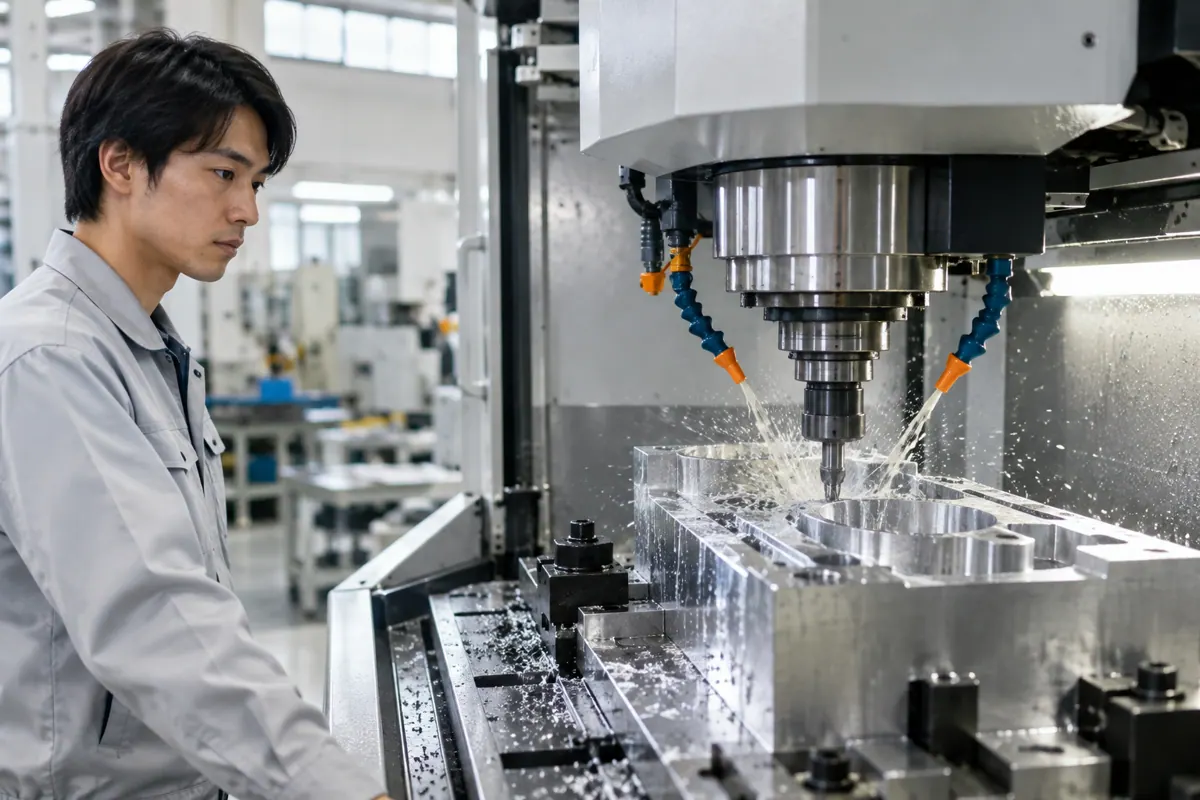
In your equipment list, include the machine name, maker, number of units, and the range it can handle. Two kinds of photos — the whole machine and the machine in operation — convey both the scale of the factory and how actively it runs.
For quality control, show the certifications you hold
If you hold a certification such as ISO 9001, state the year obtained and the scope of certification. Adding your inspection process and the measuring instruments you use shows your attitude toward quality. Even without certification, writing your inspection procedures and how you keep records conveys your commitment to quality.

How to build a path that leads to quote requests
Create a flow that lets a reader of your technical page request a quote right away.
- Place a quote request button at the end of each technical page
- Add a field to the request form for attaching drawing files
- Limit the input to four items: company name, contact person, contact details, and an outline of the request
- After submission, show a confirmation of receipt and the expected number of days until a reply
- For those who want to sign a non-disclosure agreement before sending drawings, include a note inviting them to discuss it
Some people want to consult through the inquiry form before sending drawings, while others want to attach a drawing and request a quote immediately. Providing two entry points means you miss neither type of request.
Features and structure a manufacturer's website should have
Build a manufacturer's website with the following pages and purchasing staff will not get lost.
- Home. State in one sentence what your company makes and which industries you supply
- Technology and machining pages. One page per process
- Equipment page. A list and photos
- Products and delivery records page. Industry, product type, challenge and solution
- Quality control page
- Company profile. Location, founding, number of employees, industries of clients
- Recruitment information. A page that shows what the work on the manufacturing floor is like
- Quote requests and inquiries
Even when you cannot name your clients, writing the industry and product type — such as “prototypes for automotive parts” or “housings for medical devices” — works as proof of what you can do.
If you also have overseas clients, prepare English pages. Using a system that automatically translates your website content into English makes it easier to reflect Japanese updates in the English version.
Using it as an entry point for recruiting too
The labor shortage in manufacturing continues at many sites. The equipment and machining photos you show on your technical pages double as material that helps job seekers picture the work. Building the site so visitors can move between the technical pages and the recruitment pages makes your website work for clients and job seekers alike.
Common mistakes in building manufacturers' websites
Only product photos lined up, with no explanation of the technology
Product photos show how the finished item looks, but they do not convey how it was made or how far your capabilities go. Below each photo, write the material, dimensions, processes used, and the points you worked out.
Writing in technical jargon that the buyer does not understand
The person placing the order is sometimes a purchasing officer rather than a designer. When you use technical terms, add a short explanation. For example, adding that tolerance means “the allowable deviation in dimensions” makes it clear to purchasing staff as well.
Updates stop
A site whose last update was years ago raises the question of whether the factory is still running. Put in place a system that lets you add equipment changes and new delivery records several times a year.
Drawings cannot be viewed on a smartphone
On site or while traveling, some people research companies on a smartphone. Check for problems such as tables running off the screen or photos that are too small on a smartphone before you launch.
What to check when hiring a web production company
When you commission a manufacturer's website, check the following points.
- Can they understand your machining terminology through interviews?
- Can you also commission photography of equipment and products?
- Can you ask them to add equipment and records after launch?
- Do they handle structured data and article additions so you can be found in search?
Merci Ltd. was founded in February 2001 and handles everything in-house, from website design to photography, video production and system development. For custom-made production, our creators interview you to organize your strengths and spend time on strategic planning and design. Because coding into WordPress is largely left to AI, initial costs start from 250,000 yen (around 5 pages) or 500,000 yen (around 10 pages), with monthly fees from 3,000 yen.
An example of how to write a delivery record page
Writing each delivery record in the same format makes them easy to compare. The format has four parts: the background of the request, the challenge, the machining applied, and the result.
| Item | Example of how to write it |
|---|---|
| Industry and product | Positioning parts for industrial machinery |
| Background of the request | Several types of prototype had to be made in a short period |
| Challenge | The material was stainless steel and the dimensional tolerance was tight |
| Machining applied | Cutting, plus 100% inspection by measurement after machining |
| Result | Design corrections were identified early, at the prototype stage |
Include numbers wherever you can: lead times in days, lot quantities, tolerance values and so on. When you cannot publish figures, simply describing the challenge and your response in concrete terms still lets purchasing staff judge whether it resembles their own request. As a guide, use two photos: the whole finished item and a close-up of the machined area.
Metrics to watch after launch
After launch, review not only the number of quote requests but also the number of visits to each technical page, once a month. A page with many visits but few quote requests may lack details on dimensions or materials. Conversely, a page with few visits often has a process name that does not match the words people search for, so review its title.
FAQ
You can start with around seven pages: home, machining technology, equipment, quality control, delivery records, company profile and contact. If you offer many types of machining, add a page for each process.
Write the industry and the product type. Simply writing “parts for industrial machinery” or “jigs for food factories” conveys what you can do.
Build the file upload form on a page with encrypted communication. You also need to decide internally where submitted drawings are stored and who may view them. If a non-disclosure agreement is required, place a note about consulting first before the form.
Yes, we can. Using an automatic translation system makes it easier to reflect updates to your Japanese pages in the English pages as well.
It varies with the number of pages and the depth of the build. As a guide for custom-made production, around 5 pages start from 250,000 yen, around 10 pages from 500,000 yen, and monthly fees from 3,000 yen. If you add photography or an English version, we will quote according to the content.
We decide the structure of your technical pages together in a meeting
For a manufacturer's website, results are decided by the technical figures you publish and the path leading to a quote request. How to organize your strengths and which process to turn into a page first is something we will advise on after hearing about your current business situation.